

Why Entering a New Market Is Like a Second Founding
In strategy decks, international expansion often appears as the logical next step. Product validated. Revenue growing. Home market stable. So let’s scale.In reality, expansion is not a rollout. It is a second founding under different conditions. Underestimate that, and you will pay twice. Once financially. Once strategically. For founders, intrapreneurs and CEOs, a new country is not an additional sales channel. It is a new system with its own incentives, cultural codes and structural constraints.
 1. Strategic Fit: Why This Country and Why Now?
Before translating your website, ask the uncomfortable questions:
- Does the same problem exist with the same urgency?
- Does your business model still work under local cost structures, taxes and salary levels?
- Is there a dedicated expansion team, or is this a side project?
Expansion is a capital allocation decision.
Do not try to “go faster” until your core business at home is stable, because expansion will make existing problems blow up faster.
 2. Market Research
Professional expansion follows a structured research logic. Three layers. In this order.
2.1 Desk Research
You need to understand your playing field. The goal is to narrow down the options intelligently.
- Market size and growth
- Competitive landscape
- Regulatory environment
- Purchasing power and consumption patterns
- Public funding and support structures
In our recent SCALEup Talk, we spoke with Caroline Schober, founder of neworn. It became clear just how systematic this phase needs to be. The team first analyzed multiple European markets, then prioritized those where sustainability, brand affinity, and market dynamics aligned with their model.
Zoom out. Then zoom in.
2.2 Qualitative Research
Many expansions fail because the founders misunderstood how people actually think and decide. Qualitative research is how you prevent that. Here is what that looks like in practice. First, define your key segments. For a platform like neworn, that meant distinguishing clearly between buyers and sellers. In B2B contexts, it could mean separating economic buyers, technical evaluators and end users.
Second, conduct in depth interviews. Three to five interviews per core segment is the minimum to identify patterns. These conversations should explore:
- How people currently solve the problem
- What triggers a purchase decision
- What creates trust or skepticism toward a foreign company
- How important price, brand, sustainability or convenience really are
- What would stop them from switching
Third, look for recurring themes. Not single opinions, but repeated signals across interviews. Before entering Germany and Poland, neworn spoke directly with parents in both markets to understand buying behavior, brand perception and local dynamics. The outcomes were clearly different.
In Poland, the app needed full translation. English would not have been sufficient for adoption. Brand orientation in Poland turned out to be stronger than pure sustainability messaging. In Germany, the picture was more nuanced. Even within one country, behavior varies. Parents in Berlin tend to place greater emphasis on sustainability and let that influence purchasing decisions, whereas in Munich brand perception plays a stronger role.
These are not marginal details. They affect language, feature prioritization, marketing arguments and pricing communication.
Qualitative research gives you context. And context determines strategy.
2.3 Quantitative Validation: Measure the Hypotheses
Once you have spoken to people in a new market, you will start to see patterns. For example, several interviewees might say they care more about brands than sustainability. Or that buying new clothes is easier because the item is available in all sizes, and they do not have time to look for suitable options in a second-hand store. These are good insights, but they are based on a small number of conversations. Now you need to check if they hold true at scale.
Here is how you do that.
Surveys to test willingness to pay
If 10 interviewees tell you they would pay 5 euros per month for an app that curates suitable and sustainable second hand children’s clothing, that is a promising signal. But it is still only a signal.
To test whether this willingness is real, you can run a simple market experiment.
Send an email to a few hundred people in your defined target group and announce that the app will launch soon. Invite them to join a waiting list and clearly state that access will cost 5 euros per month.
If a meaningful number of people actively sign up under those conditions, you are no longer measuring polite interest. You are measuring real intent.
People who register despite the stated price are demonstrating a concrete willingness to pay, not just theoretical approval.
This type of test helps you assess whether your price point is viable in the broader market before you invest heavily in development or marketing.
Localized test campaigns
Create simple landing pages in the local language with different messages. One focuses on sustainability, another on price, another on premium brands. Run small online ads and measure what people click on. Behavior shows you what really matters.
Competitive data
When conducting a competitor analysis for a new market, start by clearly identifying your direct and indirect competitors. Direct competitors solve the same problem in a similar way. Indirect competitors address the same need through alternative solutions.
Next, analyze their market traction. Use available tools to estimate website traffic, app downloads and visibility. This gives you an indication of demand and market maturity.
Then evaluate their positioning. What value proposition do they emphasize? Price, quality, sustainability, convenience? Study their messaging, pricing structure and target segments.
After that, examine customer feedback. Reviews and comments often reveal weaknesses, unmet needs and recurring frustrations. These insights highlight potential differentiation opportunities.
Finally, assess their business model logic. How do they monetize? Where might their cost structure create vulnerabilities? A structured competitor analysis is about understanding the competitive landscape so you can position strategically rather than emotionally.
 3. Market Entry: Focused Instead of Nationwide
When expanding internationally, launching across an entire country from day one sounds logical. If the product works in a market, why not make it available everywhere?
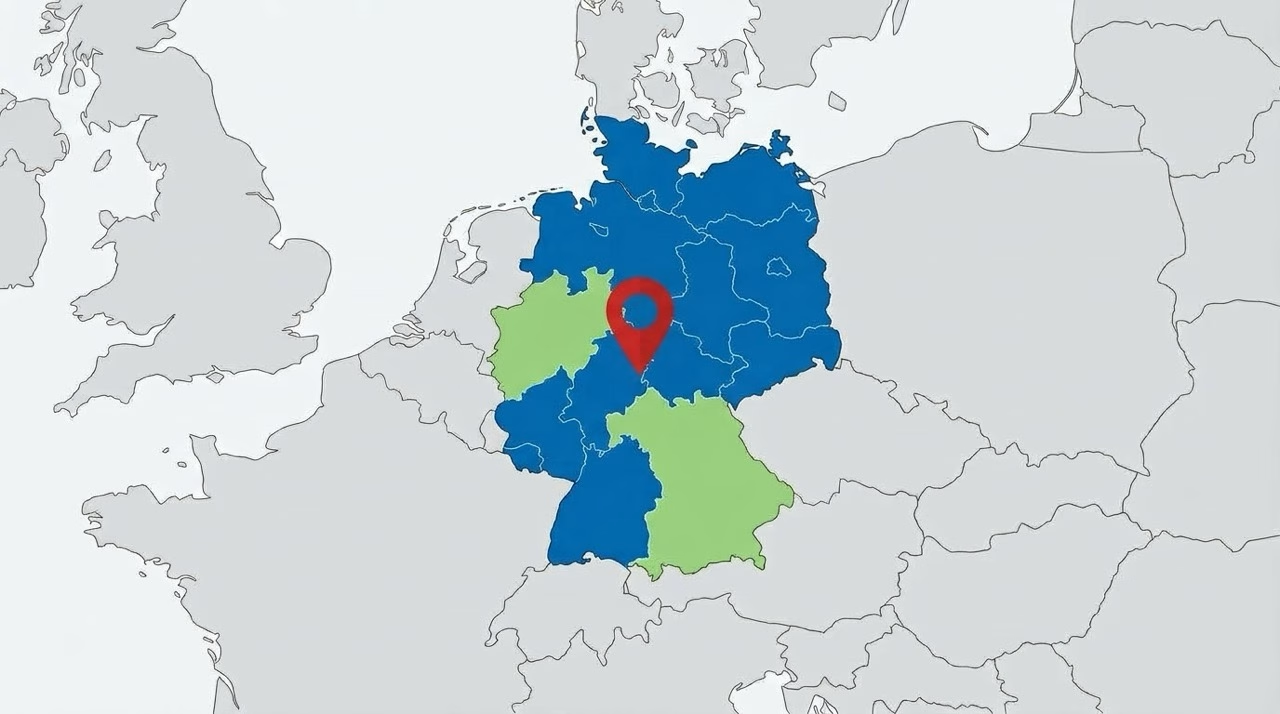
The problem is that markets are rarely homogeneous. Cultural attitudes, purchasing behavior, income levels, and communication styles can differ significantly between regions.
When entering Germany, for example, neworn deliberately avoided a nationwide launch. Instead, the team started regionally with a focus on Bavaria and the Munich area .
This approach has several strategic advantages.
First, it concentrates marketing resources. Instead of spreading budget thinly across the entire country, campaigns can be targeted in one region where awareness can build faster.
Second, it enables faster learning. A focused launch allows the team to test messaging, pricing and product features in a defined environment.
Third, it reflects cultural realities. Even within the same country, preferences can vary widely. For instance, urban areas such as Berlin may respond more strongly to sustainability messaging, while regions like Munich may place greater emphasis on brands and perceived quality. Launching regionally allows companies to understand and adapt to these nuances.
In short, regional entry reduces financial risk and increases learning speed. Once product–market fit is confirmed locally, expansion to additional regions becomes significantly more predictable.
 4. Funding and Structural Readiness
Expansion costs more than your initial spreadsheet suggests.
neworn actively leveraged public funding programs to support internationalization and marketing.
Before entering a new market, clarify:
- Funding instruments
- Tax implications
- Need for a local legal entity
- Data protection and sector specific compliance
Regulatory complexity is not an afterthought. It is either a growth barrier or a competitive advantage.
5. A Practical Expansion Checklist
Strategy
- Clear business case per country
- Defined customer segments
- Secured runway and team capacity
Research
- Market size, competition and regulation analyzed
- At least three to five qualitative interviews per core segment
- Willingness to pay validated
Entry Design
- Regional focus
- Localized positioning and messaging
- Adjusted pricing structure
Structure
- Tax and legal framework clarified
- Data protection reviewed
- Funding instruments evaluated
Pilot
- Six to twelve month test phase
- KPIs defined: customer acquisition cost, sales cycle, retention, contribution margin
- Data driven scale or exit decision
Conclusion
International expansion is a new system you have to build.
If you take a structured approach, respect local differences, and test ideas step by step, you are far more likely to succeed.
If you think a translated pitch deck is enough, you will quickly learn how costly that mistake can be.
For a real-world look at expanding from Austria into Germany and Poland, listen to the latest episode of SCALEup Talk with Caroline Schober from neworn. Caroline shares the lessons learned and reveals how being a founder shapes your personality.